
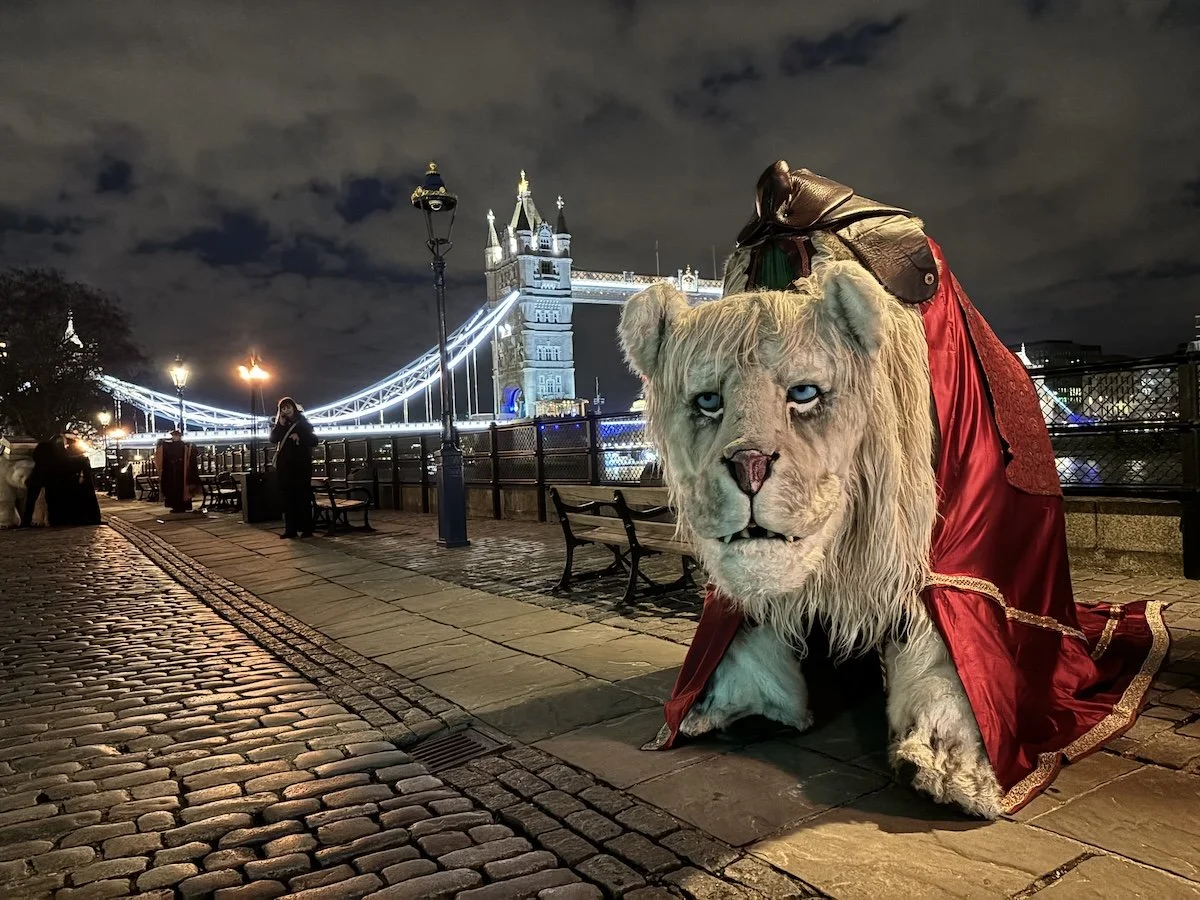
As artists, we make work for the world we want to inhabit. Any creative practice, any business, is about taking the invisible and making it visible — through our vision and labour, we call into being that which we wish to exist. In this way, both business and arts practice can be seen as spiritual. Creature Encounter sits at the centre of this Venn diagram as a commercial puppetry company.
The world we wanted to inhabit was one where art enlivened the street, where high-quality puppetry celebrated children and childhood in the public square — free at the point of delivery, not hidden behind the paywall of a theatre, bringing communities together to connect, play, share and celebrate life. This was the world we were trying to call into being. As artists, in our own childhoods, we had found refuge in the fantasy films and practical effects of the age, and a safe harbour and sense of significance in our ability to make characters with our hands. Now, as adults, we were driven by those same animating instincts — using creative skills begun in childhood to recreate those moments of refuge and safety, and pay them forward to today's children. Looking back, I can see that this socially useful model of arts practice had its roots in the New Labour era that preceded us.
Creatures was born two years before the 2008 financial crisis. By the time we had found our footing, an economic earthquake was ripping across the globe. I remember arriving at an event to be told by the organiser, "The party's over — but we've had a good twenty years." It was disheartening, but we pushed on through the austerity years, holding the vision and trusting the process. Over the next decade, our turnover and profits steadily increased, and we transitioned from self-employment into a limited company — or, as a fellow performer put it, "a very limited company." We took on a small warehouse space, which grew in time to include a workshop and office. Throughout these years, we funded the development of new work, creating more successes than failures, evolved our distinctive methodology, travelled internationally, and nurtured a deep pool of freelance talent in our city. As the company's reputation grew, Jamie and I were pushed further into the back room managing day-to-day operations, until finally that sweetest of days arrived and we hired an administrator. After a decade of work, it felt like we had arrived.
Then Brexit took a third of our turnover overnight. Our largest client was exposed to the downturn in consumer confidence that followed the referendum, and the slow-puncture effect was immediately visible as annual turnover and profits began to decline. We continued working internationally — trips to Moscow, multi-day contracts across the UK — but the trajectory had shifted. Then came the pandemic. We cut everything we had built over fifteen years, surviving only because of the Cultural Recovery Fund. The world we emerged into was transformed. Russia's invasion of Ukraine ended our trips to Moscow. The wars in the Middle East ended our frequent work across the Gulf. We have not had an enquiry from Europe since Brexit.
Now, more than ever, we are trapped on our little island, unable to outrun the domestic economy. For twenty years, when reflecting on our situation, we always expected the UK economy to return to the growth rates that preceded the crash. It never has, and circumstances have only worsened. That prophetic event organiser was right: the party was over. For a long time now, it has felt like starting again — forced through the eye of the needle, stripped of everything we built. The nature of the work has changed too. Before 2008, every town and city had an annual arts or children's festival, held in local parks or throughout the city centre. After the crash, we found ourselves in the service of marketeers, deployed by shopping centres and retail districts to increase footfall and dwell time, fighting the bricks-and-mortar death spiral. Today, even that middle ground has been hollowed out. More often than not, we work at the extremes of poverty and wealth — for affluent enclaves or forgotten towns, rarely anywhere in between.
It has been a disheartening experience, watching the cultural world we fought to create recede as the country that made us declines. Children and childhood are celebrated in the public square less and less. Art enlivens the street only rarely now. Less work means Jamie and I travel together as frequently as we did at the very beginning — climbing out of the van in each new place, watching the seasons change, and wondering when the world we once imagined might be possible again.